
A 2026 Guide to Types of Cruises
Quick answer: There are seven main types of cruises – mainstream, premium, luxury, luxury branded megayacht, expedition, river, and barge. Each is built for a different kind of traveler. The right choice depends less on destination and more on how you want to feel onboard: entertained, pampered, immersed, or deep in one place.
By Julie Jones, Virtuoso Top Producer in Luxury & Expedition Cruises | Travel + Leisure A-List Advisor | Condé Nast Traveler Top Travel Specialist
“Luxury” gets used for almost everything in this industry – a mainstream ship’s top suite, a river cruise brochure, a five-star expedition ship crossing the Drake Passage. None of it’s false advertising exactly. It’s just imprecise, and that imprecision makes it genuinely hard to know what you’re comparing.
I’ve spent 14 years matching travelers to the right ship. The question I hear most isn’t “which line is best.” It’s “I don’t even know where to start.” Here’s how I explain each category to clients – what it actually includes, who it’s built for, and where most people go wrong.
Cruise Types at a Glance (2026)
Type |
Guest Count |
Staff Ratio |
Pricing Model |
Best For |
|---|---|---|---|---|
| Mainstream | 3,000-7,000+ | ~1:3 | Base fare + extras | Families, first-timers |
| Premium | 700-2,500 | ~1:2 | Semi-inclusive, varies | Step-up cruisers |
| Luxury | 100-750 | ~1:1 | Mostly all-inclusive | Couples, solo travelers |
| Luxury Branded Megayacht | 110-300 | 1.5:1+ | Fully all-inclusive | Ultra-luxury, hotel loyalists |
| Expedition | Under 200 | Varies | Semi-inclusive | Adventure travelers |
| River | 100-190 | Varies | Often all-inclusive | Culture-focused travelers |
| Barge | 6-24 | Very high | Fully inclusive | Small groups, private charters |
What Is a Mainstream Cruise Ship?
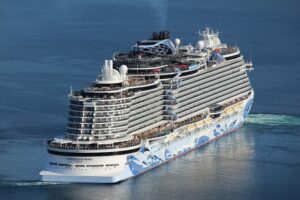
Mainstream ships carry 3,000 to over 7,000 guests – waterslides, Broadway-style shows, a dozen dining venues, and enough onboard activity to fill a week without ever setting foot on land. Royal Caribbean, Carnival, Norwegian, and MSC operate in this space.
The base fare gets you aboard, but dining, drinks, Wi-Fi, and gratuitiesare almost always extra and add up faster than most people expect. Staff-to-guest ratios run around 1:3, so service is efficient rather than personal. Expect lines – at the buffet, the gangway, sometimes your own dinner reservation.
The ship is the destination here.
Best for: Families with a wide age range to entertain, first-timers testing whether cruising suits them, and anyone who wants maximum activity at the lowest entry price.
What Are Premium Cruise Lines?
Premium lines – Holland America, Oceania, Viking – carry 700 to 2,500 guests and feel noticeably more refined than mainstream: better food, more attentive service, smaller crowds, and a quieter onboard atmosphere.
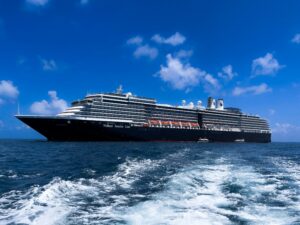
The catch: “premium” has no fixed definition. Inclusions vary line to line and sometimes sailing to sailing, so the fare comparison you think you’re making often isn’t apples to apples. Read the fine print before assuming what’s covered.
This tier suits travelers who want more polish than mainstream without committing to all-inclusive luxury pricing – and who don’t mind building their own package of extras.
Best for: Experienced cruisers stepping up in quality, and travelers who prefer à la carte flexibility over a bundled fare.
What Are Luxury Cruise Lines?
Luxury cruise lines – Silversea, Regent Seven Seas, Seabourn, Crystal – carry 100 to 750 guests. 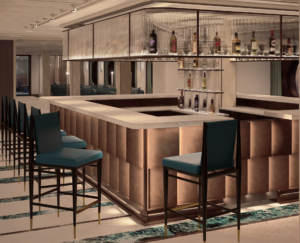
Staff-to-guest ratios sit near 1:1. Fine dining, premium spirits, gratuities, and often shore excursions are folded into the fare – the price you see is close to the price you’ll pay. Smaller ships also reach ports the big ones can’t: the Santorini caldera, the inner channels of the Norwegian fjords, harbors with no room for a 5,000-guest vessel.
The cost of a luxury cruise looks steep next to a mainstream cruise for the same itinerary length, but once you tally what a mainstream cruise actually costs by the last night – specialty dinners, a drinks package, gratuities, excursions – the gap closes fast. I see people stop at the headline number and never do the math. It’s the most common comparison mistake I encounter.
Best for: Couples and solo travelers. Larger ships (500-750 guests) from lines like Crystal and Regent also work well for multi-generational families who want space without sacrificing the all-inclusive model.
What Are Luxury Branded Megayachts?
 The newest category, and the one clients ask me about most right now, include Ritz-Carlton Yacht Collection, Four Seasons Yachts, Aman at Sea and Orient Express Corinthian, which has gotten the most attention this year.
These are hospitality brands building ships from scratch, and it shows. Corinthian carries just 110 guests across 54 suites on a 220-meter hull — a mainstream mega-ship’s length with a river boat’s guest count. She’s currently the largest sailing yacht in the world, powered in part by a rigid sail system that can cut the engines in the right wind. Onboard: a restaurant from Michelin-starred chef Yannick Alléno, a Guerlain spa, and close to 170 crew, with a butler assigned to every suite. I got an early look at her before she opened, and what stayed with me wasn’t the size — it was how quiet she felt for a ship that large.
What separates this category from traditional luxury lines is brand pedigree. These aren’t cruise companies adding a luxury tier — they’re hotel groups building the ship they’d want to stay in themselves, with suite sizes and staff ratios closer to a private villa than a ship. Best for travelers who want the smallest possible guest count without sacrificing scale, and for anyone chasing something genuinely new.
What Is an Expedition Cruise?
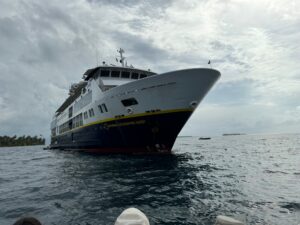
Expedition ships are built for where you’re going, not how you’re getting there – zodiacs, kayaks, ice-class hulls, and onboard naturalist guides instead of casinos and pool decks. Lindblad Expeditions, Quark, Ponant and more carry fewer than 200 guests to Antarctica, the Arctic, the Amazon, and the Galápagos.
Days are structured around landings and lectures. Weather and ice can rewrite an itinerary overnight, and crossings like the Drake Passage can be genuinely rough. I’ve made that crossing – it’s still one of the most extraordinary things I’ve done in this business. The reward is proportional to the effort.
One practical note: book early. The best cabins on top expedition ships sell out 12 to 18 months before departure.
Best for: Active, curious travelers who want to learn as much as they see – and whose bucket list includes hard to reach destinations such as Antarctica, the Arctic, or the Galápagos.
What Is a River Cruise?

River ships are small by necessity – locks and bridges only allow so much – and carry 100 to 190 guests along the Danube, the Rhine, the Mekong, the Nile, and dozens of other waterways. AmaWaterways, Riverside, and Uniworld are the names I recommend most often in this category.
The pace is slow and the immersion is deep. Ships dock in the heart of cities – walking distance from a cathedral, a market square, a vineyard. No tender, no shuttle: you simply walk off. The water stays calm for virtually the entire journey, which makes river cruising the most accessible option for anyone who worries about motion sickness.
The tradeoff is range. A river itinerary goes deep into one region rather than wide across several. That’s a feature for the right traveler. I’ve put skeptics on river cruises and watched them convert – there’s something about a glass of local wine on deck as a centuries-old castle drifts past at sunset that does the selling for me every time.
Best for: Culture-focused travelers, anyone who prefers calm water, and those who want to wake up in a different city every morning without repacking a bag.
What Is a Barge Cruise?
Barge cruising is the quietest category in this guide – converted canal barges carrying 6 to 24 guests through the waterways of France, the Netherlands, Belgium, and England at barely faster than walking pace.
Most barges are chartered privately by a single group  or family. Others share a handful of cabins with one crew looking after everyone aboard. Guests frequently cycle or walk the towpath alongside the barge and rejoin it a lock or two later. Meals reflect whatever the chef found at the local market that morning – there’s no set menu and no dining room with 200 strangers in it.
There’s also no entertainment deck, no casino, and nowhere to disappear if you need space from your travel companions. For the right group, that’s exactly the point. For the wrong one, it’s a dealbreaker – and worth knowing before you book.
Best for: Small groups, families wanting a fully private charter, and travelers who want to go as deep as possible into one region without any of the infrastructure of a larger ship.
How Do You Choose the Right Type of Cruise?
Start with how you want to feel, not where you want to go.
- Entertained and active? Mainstream or premium.
- Pampered, with fewer people around? Luxury or luxury branded megayacht.
- Somewhere most ships can’t reach? Expedition.
- Deep in one culture, calm water, city-center docking? River.
- Total privacy, one region, one small group? Barge.
The category usually picks itself once you answer that question honestly. From there, the real work is matching the specific line, ship, itinerary, and cabin category to your travel companions and your season – and that’s where knowing which brochures to trust and which to read carefully makes the difference.
Ready to Find the Right Cruise for You?
Done right, a cruise is one of the best ways to see the world. You wake up somewhere extraordinary, someone else is handling the logistics, and the only decision is how you want to spend the day.
Getting there takes more than picking a destination. Ship, line, itinerary, cabin category, timing – miss on any one and a good trip stays just a good trip instead of the one you talk about for years.
I’m a Virtuoso Top Producer in Luxury and Expedition Cruises, a Travel + Leisure A-List advisor, and a Condé Nast Traveler Top Travel Specialist. More than any of that, I’ve sailed the ships I recommend. I know where the brochure and the real thing line up – and where they don’t.
Reach out to me at TopFlight Travels and let’s figure out the right cruise for you. There’s no fee for the planning, and the preferred-partner perks cost you nothing extra.
Frequently Asked Questions About Cruise Types
What is the difference between mainstream and luxury cruises?
Mainstream cruises (Royal Caribbean, Carnival, Norwegian) carry 3,000 to 7,000+ guests with a la carte pricing – dining, drinks, and gratuities are usually extra. Luxury cruises (Silversea, Regent, Seabourn) carry 100 to 750 guests and are almost always all-inclusive. The staff-to-guest ratio jumps from roughly 1:3 on mainstream ships to near 1:1 on luxury ships.
Are luxury cruises worth the extra cost?
Often yes, once you do the full math. A mainstream cruise fare looks cheaper upfront, but add nightly specialty dinners, a drinks package, gratuities, and shore excursions, and the gap closes significantly. Luxury fares typically include all of those, plus smaller ships, better service, and access to ports large ships cannot reach.
What type of cruise is best for first-time cruisers?
Mainstream ships are the most common starting point because of their lower entry price and wide range of onboard activities. That said, I’ve put first-timers directly on luxury or river cruises and they’ve never looked back – the experience is simply easier and more personal. The “start with mainstream” advice is conventional, not universal.
What is the best type of cruise for couples?
Luxury cruise lines and luxury branded megayachts are consistently the best fit for couples. The intimacy of a smaller ship, the all-inclusive model (no nickel-and-diming at dinner), and the access to quieter, less-crowded ports create the right conditions for the trip to actually feel like an escape. River cruises are also excellent for couples who want cultural depth over beach destinations.
What is the best cruise type for adventure travelers?
Expedition cruises are built specifically for adventure travelers. Ships from Lindblad, Hurtigruten, and Ponant carry naturalist guides, zodiacs, and ice-class hulls to destinations like Antarctica, the Arctic, and the Galápagos. Book 12 to 18 months in advance – the best cabins sell out well ahead of departure.
What is a luxury branded megayacht cruise?
A luxury branded megayacht cruise is offered by a hospitality brand – Ritz-Carlton, Four Seasons, or Orient Express – that has built a ship from scratch rather than adapting a cruise ship model. Guest counts are extremely low (110 to 300), staff ratios exceed 1.5 crew per guest, and everything from dining to excursions is typically included. The Orient Express Corinthian, launched in 2026, is the most talked-about example currently sailing.
Ready to Find the Right Cruise for You?
Done right, a cruise is one of the best ways to see the world. You wake up somewhere extraordinary, someone else is handling the logistics, and the only decision is how you want to spend the day.
Getting there takes more than picking a destination. Ship, line, itinerary, cabin category, timing – miss on any one and a good trip stays just a good trip instead of the one you talk about for years.
I’m a Virtuoso Top Producer in Luxury and Expedition Cruises, a Travel + Leisure A-List advisor, and a Condé Nast Traveler Top Travel Specialist. More than any of that, I’ve sailed the ships I recommend. I know where the brochure and the real thing line up – and where they don’t.
Reach out to me at TopFlight Travels and let’s figure out the right cruise for you. There’s no fee for the planning, and the preferred-partner perks cost you nothing extra.